Why Ergonomic Desk Stools Health Impact Matters More Than You Think
Ergonomic desk stools health impact is real, measurable, and affecting millions of office workers every single day — most of whom don’t even realize it yet.
Here’s a quick snapshot of what the research shows:
| Health Area | Impact of Ergonomic Desk Stools |
|---|---|
| Back & Neck Pain | Reduced by supporting natural spinal curves |
| Circulation | Improved through waterfall seat edges and movement |
| Posture | Closer to natural standing alignment vs. standard chairs |
| Fatigue | Lowered, leading to better focus and energy |
| Productivity | Up to 70% of users report improved performance |
| MSDs | Risk reduced through active sitting and postural variety |
Think about this: Americans spend 8–9 hours a day sitting at work. People globally now average 10.4 hours of sitting per day total. And at least 63% of office workers report extreme physical discomfort from their workstations.
That discomfort isn’t just annoying. It’s costly.
Work-related musculoskeletal disorders (WMSDs) cost the US economy $54 billion in a single year — and that’s before accounting for lost focus, lower output, and burned-out employees.
The chair — or stool — underneath you right now is either helping or hurting. And for most people, it’s quietly doing damage.
Your seat shapes your spine, your energy, and yes, even your ability to get things done. The good news? The right ergonomic desk stool can reverse much of this harm. This guide breaks down exactly how.
The Hidden Ergonomic Desk Stools Health Impact on Your Body
When we talk about “killing your vibe,” we aren’t just talking about a bad mood. We are talking about the physiological shutdown that occurs when you park your body on a non-supportive surface for eight hours. The ergonomic desk stools health impact starts at the base of your spine and radiates through your entire nervous system.
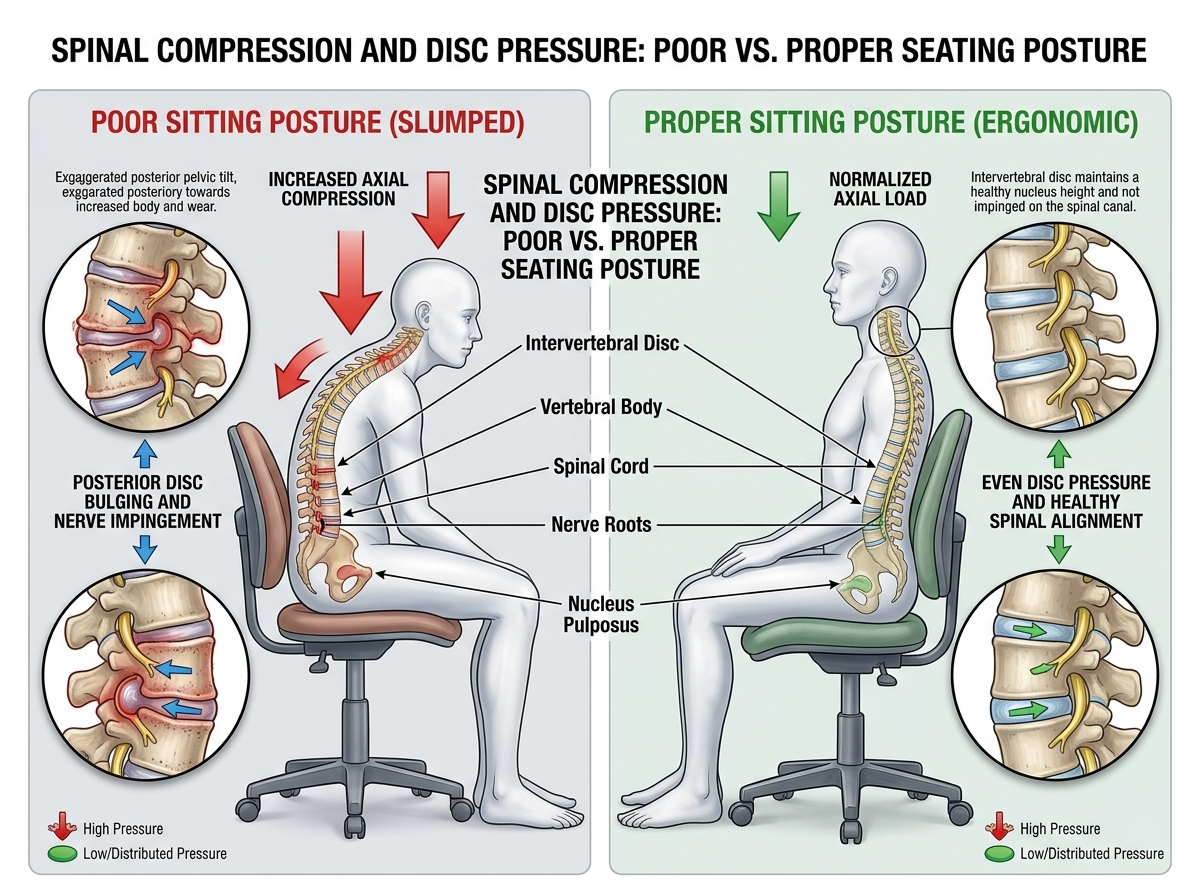
Prolonged sitting in a traditional, static chair often leads to what experts call “passive sitting.” In this state, your muscles go slack, your pelvis tilts backward, and your spine loses its natural “S” curve, collapsing into a “C” shape. This misalignment isn’t just a posture problem; it’s a precursor to Work-related Musculoskeletal Disorders (WMSDs).
According to A systematic review of research on sitting and working furniture ergonomics, sedentary behavior at poorly designed workstations is linked to significant detrimental health effects. These include chronic back pain, restricted circulation, and a host of occupational diseases. When your chair lacks the proper support, your body compensates by straining ligaments and overworking certain muscle groups, leading to the “extreme discomfort” reported by over 60% of office workers.
Musculoskeletal Risks of Non-Ergonomic Seating
The risks of a bad seat are anatomical. Without the dynamic support of an ergonomic stool, many workers suffer from increased thoracic kyphosis (a rounded upper back) and a loss of lumbar lordosis (the natural inward curve of the lower back). This “slumping” puts immense pressure on the intervertebral discs.
Furthermore, static seating can lead to nerve pressure. If you’ve ever felt numbness or tingling in your legs, your chair might be cutting off blood flow or compressing the sciatic nerve. This is why we advocate for non-toxic ergonomic office chairs that prioritize both physical alignment and material safety.
The Economic Cost of Poor Workplace Ergonomics
At FinanceInvestX, we look at health through the lens of investment. Poor ergonomics is a “bad debt” that accumulates interest in the form of medical bills and lost wages. In Europe, 38.1% of occupational diseases are work-related musculoskeletal disorders. In the U.S., WMSDs account for one-third of all lost workdays.
The $54 billion annual cost to the U.S. economy isn’t just a corporate problem—it’s a personal one. Absenteeism and the cost of physical therapy or surgery can derail a professional’s financial goals. Investing in a high-quality stool isn’t a luxury; it’s a risk-mitigation strategy for your most valuable asset: your body.
How Ergonomic Stools Mitigate Musculoskeletal Disorders
Standard chairs often act like a “cast” for your body, allowing your core muscles to switch off. Ergonomic desk stools, particularly “active” or “dynamic” models, change the game by encouraging movement. This concept, known as active sitting, requires your body to make micro-adjustments to stay balanced.
Scientific research on trunk posture adaptations during sitting on dynamic stools shows that sitting on a dynamic stool provides a significantly better match to the physiological spinal curvature seen during standing compared to conventional sitting. By engaging the core, these stools reduce the static load on the spine and decrease pressure on intervertebral discs. For more on the specific types of seating that promote this, check out our guide on non-toxic ergonomic desk stools.
Improving Circulation and Metabolic Health
One of the most immediate ergonomic desk stools health impact benefits is improved blood flow. Traditional chairs often have hard edges that press into the underside of the thighs, acting like a tourniquet. Ergonomic stools typically feature “waterfall” seat edges—contoured fronts that slope downward—to keep blood circulating freely to the lower limbs.
Beyond just comfort, this has metabolic implications. Research highlighted in an evidence-based guide on standing desk health benefits suggests that reducing sedentary time and improving posture can positively affect insulin resistance and vascular function. When you move more, your body processes glucose more efficiently.
Psychological Benefits and Cognitive Performance
The connection between the spine and the brain is direct. When you are in pain, your brain’s “bandwidth” is consumed by managing that discomfort, leaving less energy for deep work. Ergonomic seating has been shown to improve focus and job satisfaction.
For those with ADHD or general restlessness, the ability to “fidget” or rock slightly on a balance stool provides a “brain reset.” It allows for the expulsion of excess energy, which can actually increase engagement with the task at hand. Workers who switch to ergonomic seating often report feeling more “vigorous” and less fatigued by the end of the day.
Key Features Defining a High-Performance Ergonomic Stool
Not all stools are created equal. To reap the full ergonomic desk stools health impact, you need a tool, not just a piece of furniture.
| Feature | Standard Stool | Ergonomic Active Stool |
|---|---|---|
| Seat Shape | Flat and hard | Contoured or Saddle-shaped |
| Movement | Static | Swivel, Tilt, or Wobble |
| Height | Fixed | Pneumatic/Adjustable |
| Materials | Basic foam/plastic | High-density, non-toxic, breathable |
| Base | Rigid | Dynamic or weighted for stability |
A high-performance stool should support the natural curve of your lower back, even without a traditional backrest. This is often achieved through a saddle-style seat that tilts the pelvis forward, naturally aligning the spine. For those who prefer more traditional styles, we recommend looking into eco-friendly desk chairs for posture that use sustainable, non-toxic components.
Essential Adjustments for Individual Ergonomic Desk Stools Health Impact
To maximize the benefits, you must tailor the stool to your unique dimensions:
- Seat Height: Your hips should be slightly higher than your knees. This creates an open hip angle (about 125–135 degrees), which reduces strain on the lower back.
- Weight-Shifting: A good stool allows you to lean forward or swivel easily, facilitating “postural variability.”
- Pneumatic Lifts: Ensure the stool has a smooth adjustment range so you can transition between different desk heights if you use a sit-stand setup.
Material Safety and Non-Toxic Construction
At FinanceInvestX, we believe that ergonomics isn’t just about how you sit, but what you breathe while sitting. Many cheap office stools are made with materials that off-gas Volatile Organic Compounds (VOCs). These chemicals can degrade indoor air quality and lead to long-term health issues.
We prioritize stools that use sustainable fabrics and water-based finishes. A healthy workspace is a holistic ecosystem; your stool should support your skeletal system without compromising your respiratory health.
How to Optimize Your Setup for Maximum Ergonomic Desk Stools Health Impact
Even the best stool won’t save you if your desk is a mess. Optimization is about the relationship between your stool, your desk, and your hardware.
When sitting on your stool, your elbows should be at a 90-to-100-degree angle, resting comfortably on the desk surface without shrugging your shoulders. Your monitor should be at eye level to prevent “tech neck.”
Interestingly, the research on using footstools to reduce low back pain shows that even in standing or perched positions, having a place to rest one foot can help shift weight and reduce lumbar strain. If your stool is set high for a “perching” position, a small footrest can be a game-changer.
Integrating Stools into a Sit-Stand Routine
We don’t recommend sitting—or standing—all day. The “magic” happens in the transition. The 20/8/2 rule (20 minutes sitting, 8 standing, 2 moving) is the gold standard.
Ergonomic stools are perfect for this because they are often lighter and more mobile than heavy executive chairs. You can easily slide them away to stand, or use them as a “perch” (a halfway point between sitting and standing) to give your legs a break without fully returning to a sedentary state.
Creating a Holistic Healthy Workspace
Beyond the stool, consider these factors:
- Natural Lighting: Reduces eye strain and boosts mood.
- Noise Reduction: Helps maintain the “flow state” that ergonomic comfort facilitates.
- Keyboard Placement: Should be close enough that you don’t have to reach, maintaining that crucial elbow angle.
Frequently Asked Questions about Ergonomic Desk Stools Health Impact
How does an ergonomic stool improve my daily productivity?
By reducing physical discomfort, an ergonomic stool prevents “distraction by pain.” When your body isn’t sending constant “ouch” signals to your brain, you can stay in a flow state longer. Additionally, the improved circulation and “active” nature of the stool keep you more alert compared to the lethargy often caused by sinking into a soft, unsupportive chair.
Can switching to a desk stool help with existing lower back pain?
Yes, in many cases. Most lower back pain in office workers is caused by spinal compression and a collapsed lumbar curve. Ergonomic stools, especially saddle stools or wobble stools, encourage a “neutral spine” and an open hip angle. This takes the pressure off the discs and engages the deep core muscles that support the spine. However, we always recommend consulting a professional if you have chronic issues.
What are the signs that my current office chair is damaging my health?
The most common warning signs include:
- Persistent Back Pain: Especially in the lower back or between the shoulder blades.
- Numbness: A “pins and needles” sensation in your legs or feet.
- Slouching: Finding it impossible to sit upright without conscious effort.
- Digestive Issues: Believe it or not, “scrunching” your midsection can slow down digestion.
- Frequent Headaches: Often caused by neck strain from looking up or down at a monitor while poorly seated.
Conclusion
The ergonomic desk stools health impact is a cornerstone of long-term professional wellness. As we spend more of our lives in digital workspaces, the physical tools we choose become an investment in our future mobility and mental clarity.
At FinanceInvestX, we believe that a healthy body is the foundation of a healthy career. Switching from a static, toxic chair to a dynamic, ergonomic stool is one of the simplest and most effective upgrades you can make to your life. It’s time to stop letting your seat kill your vibe and start letting ergonomics save it.
Ready to upgrade your workspace? Explore our full range of ergonomic furniture solutions to find the perfect fit for your health and productivity goals.