Why a Healthy Office Environment Matters More Than You Think
A healthy office environment is one that supports your physical health, mental well-being, and ability to do your best work — every single day. It goes far beyond a standing desk or a bowl of fruit in the breakroom.
Here’s what a truly healthy office environment includes:
- Physical safety — ergonomic furniture, clean air, proper lighting, and manageable noise levels
- Mental health support — access to confidential resources, psychological privacy, and low chronic stress
- Social connection — belonging, recognition, and genuine collaboration with colleagues
- Environmental quality — CO₂ levels below 1,000 ppm, noise below 35 dB for focused work, and 500–750 lux of task lighting
- Cultural foundation — leadership that models well-being, not just policies that announce it
Most workplaces get a few of these right. Very few get all of them.
The cost of getting it wrong is staggering. The World Health Organization estimates that workplace stress, burnout, and mental health conditions drain the global economy of roughly $1 trillion per year in lost productivity. And 80% of workers report experiencing job-related stress.
The good news? The biggest gains often come from fixing things you can measure — the air you breathe, the noise around you, the light above you, and whether you can find a quiet space when you need one.
This guide breaks down each of those factors, explains what the research says, and gives you practical steps to build a workspace that genuinely supports your health — whether you’re outfitting a full office or a home desk.
Defining a Truly Healthy Office Environment

When we talk about a healthy office environment, we have to look past the architecture. A building can be LEED-certified and beautiful, but if the culture inside is toxic, the environment isn’t healthy. As we explore what makes an office building “healthy”, we find that it is a combination of the physical structure and the psychosocial “vibe” of the team.
A healthy workplace is one where the culture, climate, and organizational practices all work together to promote both mental and physical health. This means fostering a “culture of care.” Research shows that employees who feel appreciated are 55% more likely to experience a sense of belonging at work. We aren’t just talking about a pat on the back once a year; we mean consistent, monthly recognition, which makes employees 36% more likely to be engaged.
Beyond appreciation, growth is a massive health factor. Did you know that 65% of employees leave their jobs simply because they feel they can’t grow? Nobody wants to feel like they’re stuck in professional quicksand. A truly healthy workplace provides mentorship, clear career paths, and the psychological safety to try new things without fear of retribution.
Leadership modeling is the final piece of this puzzle. Empty values are just wall art without consistent leadership modeling. If a manager tells their team to take breaks but never leaves their own desk, the team will feel pressured to do the same. When we are creating a healthy workplace, we must ensure that the “how we feel” is just as important as the “what we do.”
The Four Physical Pillars of Workplace Wellness
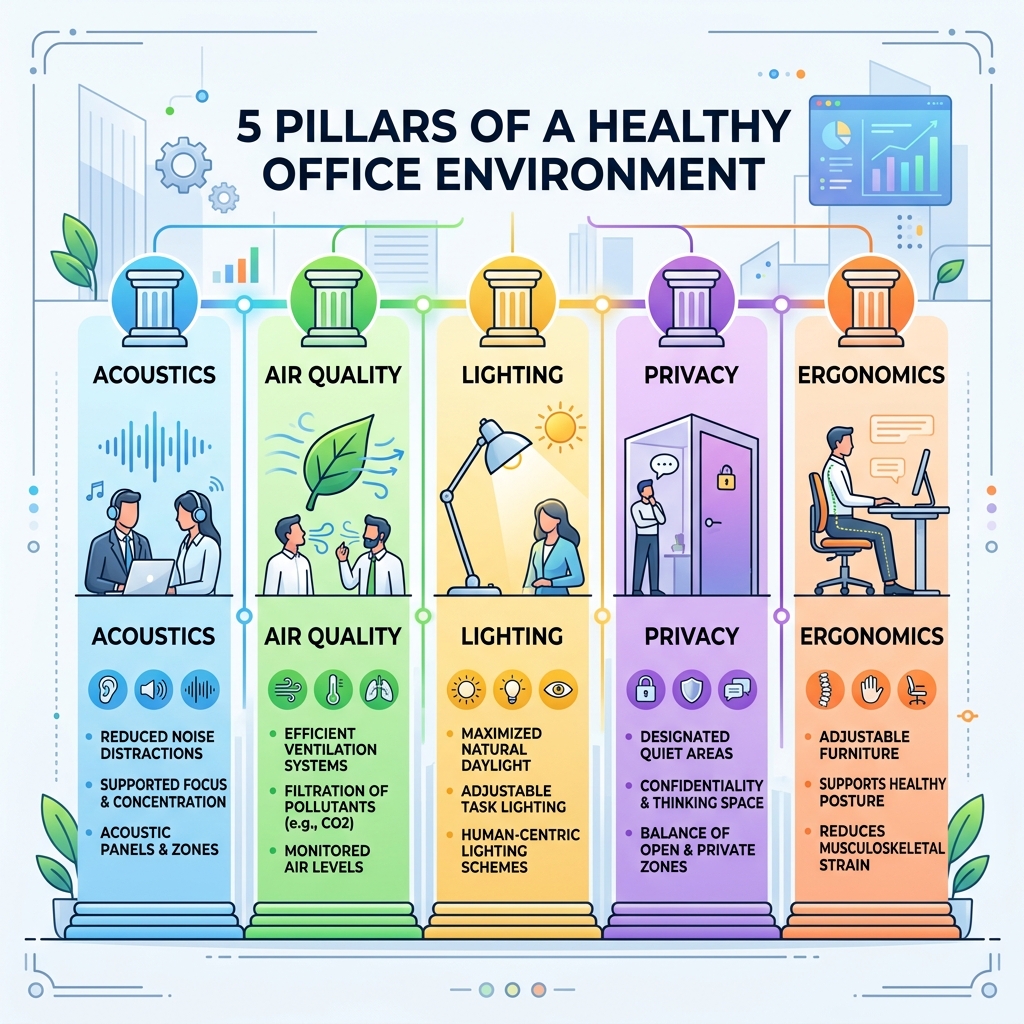
While culture is the “soul” of the office, the physical environment is the “body.” If the body is failing, the soul suffers. We can measure the health of our physical space using four critical pillars: acoustics, air quality, lighting, and psychological privacy.
| Feature | Healthy Standard (Target) | Poor Standard (Warning) |
|---|---|---|
| Acoustics | ≤ 35 dB (for focused work) | 60–70 dB (typical open office) |
| Air Quality (CO₂) | < 1,000 ppm | > 1,500 ppm (cognitive decline) |
| Lighting | 500–750 lux (task surface) | < 300 lux or flickering bulbs |
| VOC Emissions | EU E1 Standard (Low/None) | High-odor glues and cheap plastics |
These metrics aren’t just “nice-to-haves.” According to the CDC’s guide on office environments and your safety, failing to manage these factors leads to musculoskeletal disorders, eye strain, and chronic stress.
Optimizing a Healthy Office Environment through Acoustics and Air Quality
Acoustics are often the most ignored part of a healthy office environment. Most open-plan offices operate at a noise level of 60–70 dB—the range of normal conversational speech. This might seem fine, but for someone trying to do complex work, it’s a disaster. Sustained noise at these levels can reduce working memory capacity by up to 20% and extend task-completion time by 20–40%. Poor communication in a noisy space is like a slow leak in your culture; it drains energy and increases error rates.
Then there is the air we breathe. In a typical year, you will take roughly two million breaths in your office. If the air is stale, your brain slows down. Research shows that cognitive performance scores decline measurably as CO₂ rises above 1,000 ppm. By the time you hit 1,500 ppm—common in a crowded meeting room—statistically significant impairment kicks in.
Following an indoor air quality guide is essential. We recommend active ventilation systems that exchange air frequently. There’s a common myth that enclosing yourself in a small space, like a soundproof pod, makes air quality worse. In reality, modern pods with active ventilation can exchange air every 65 seconds, often providing better localized air quality than the surrounding open-plan office.
Lighting and Psychological Privacy in a Healthy Office Environment
Lighting does more than help us see; it regulates our internal clocks. For optimal alertness and well-being, office lighting should be optimized for circadian rhythms. This means using a color temperature of 5,000–6,500 K during the day to stay alert, and warmer tones (3,000–4,000 K) when it’s time to wind down. Aiming for 500–750 lux on your desk surface ensures you aren’t squinting, which reduces fatigue.
Psychological privacy is the “invisible” pillar. Studies of open-plan office workers consistently identify a lack of privacy as the single most frequent source of dissatisfaction. It’s not just about hiding; it’s about feeling safe. This is the most direct causal link between the physical workplace and mental health.
For example, most companies offer Employee Assistance Programmes (EAPs) for mental health support, yet only 3–6% of employees actually use them. Why? Because you can’t have a confidential therapy call or a private HR discussion when your coworkers are sitting three feet away. Providing private spaces, such as soundproof pods, addresses this barrier directly. You can find more on the science of acoustics, air & light to understand how these factors interact to support confidential work.
Ergonomics and Non-Toxic Workspace Design
We spend a massive portion of our lives at our desks, so the furniture we choose is a primary health intervention. Ergonomics is about designing the workspace to fit the worker, not forcing the worker to fit the space.
At FinanceInvestX, we are passionate about the impact of ergonomics on health and efficiency. We recommend starting with the foundation: your seat. Using non-toxic ergonomic desk stools or non-toxic ergonomic office chairs ensures that you aren’t just supporting your spine, but also avoiding the “off-gassing” of harmful chemicals found in many cheap, mass-produced furniture items.
Movement is the “secret sauce” of a healthy office environment. Static posture—even “perfect” posture—is hard on the body. This is why adjustable bamboo desks and eco-friendly standing desks are so valuable. They allow you to alternate between sitting and standing throughout the day, which reduces the risk of musculoskeletal disorders.
If you are working with limited room, minimalist desk setups for small spaces can help you maintain a clean, organized area that reduces mental clutter. A healthy setup isn’t just about the desk; it’s about the habits. We suggest taking short breaks every hour to stretch and rest your eyes.
The ROI of Investing in Employee Health
Some organizations view a healthy office environment as a “cost center,” but the data tells a different story. The return on investment (ROI) for workplace wellness is massive.
- Productivity Gains: Improving indoor environmental quality (air and light) can produce cognitive performance gains of 61% in focused activity and up to 101% in crisis response.
- Retention: Burnout reduction programs have been shown to cut turnover costs by 36% and keep employees at a company 20% longer. In a healthcare setting, one coaching program led to a 30% decrease in nurse turnover, saving $3 million annually.
- Health Savings: Workplace-related stress costs the global economy $1 trillion. By reducing stress, organizations save on insurance premiums and absenteeism.
When we look at 15 ways to create a healthy work environment, the common thread is that these investments pay for themselves. Whether it is through environmentally conscious workspace design or better recognition tech, the goal is to reduce the “friction” of the workday.
Practical Steps to Implement Change
Creating a healthy workplace can feel overwhelming, but you don’t have to do it all at once. We recommend a phased approach:
- Baseline Measurement: Use pulse surveys or sensors to measure your current CO₂ levels, noise, and employee stress. You can find guidance on this through resources like Healthy Workplaces TN.
- Identify Failure Points: Is the office too loud? Is the air stale by 2:00 PM? Focus on the area that is furthest below standard first.
- Physical Interventions: Deploy practical solutions. This might mean adding non-toxic desk mats and pads to reduce wrist strain or installing soundproof pods to give people the privacy they crave.
- Organize for Peace: Use minimalist office organization ideas to reduce visual noise. A cluttered desk often leads to a cluttered mind.
- Encourage Healthy Habits: Support the “Whole U.” As the University of Washington Wellness program suggests, we should prioritize movement, foster balance, and celebrate team milestones.
Frequently Asked Questions about Healthy Office Environments
What CO₂ levels are considered safe for an office?
We should aim to keep indoor CO₂ levels below 1,000 ppm. Once levels reach 1,500 ppm, you will likely notice a “brain fog” effect. This level of CO₂ significantly impairs decision-making, focus, and the ability to respond to crises. Regular fresh air exchange is the only way to keep these levels in check.
How does office noise affect long-term health?
Sustained noise in the 60–70 dB range (standard office chatter) is more than just annoying; it’s a physiological stressor. It triggers the release of cortisol, the body’s stress hormone. Over time, this leads to cognitive fatigue, increased error rates, and can even contribute to long-term cardiovascular issues. It’s why focused work requires an environment closer to 35 dB.
Why is psychological privacy important for mental health?
Without psychological privacy, employees feel “on display,” which activates social threat processing in the brain. This makes it impossible to relax or focus deeply. Furthermore, privacy is a functional requirement for mental health; if an employee can’t find a private space, they won’t use the mental health resources (EAPs) you provide, leaving them at a higher risk for burnout.
Conclusion
At FinanceInvestX, we believe that a healthy office environment is the foundation of a successful business. By focusing on the “invisible” factors like air quality and acoustics, and combining them with high-quality, non-toxic ergonomics, we can create a workplace safety culture that actually works.
Investing in your environment isn’t just about avoiding illness; it’s about unlocking the 101% gains in performance that come when a human being feels safe, comfortable, and valued. Whether you are upgrading your home office or managing a corporate floor, a healthy workplace is engineered, not just announced.
For more tips on optimizing your space, check out our more info about ergonomic accessories to find the tools that support your health and your hustle.