Why Your Workstation Height Demands the Right Tall Desk Stool
Tall desk stools are height-adjustable seats designed to pair with standing or elevated desks, letting you perch, lean, or sit at heights that standard office chairs simply can’t reach.
Here’s a quick look at the top options to consider:
| Stool Type | Best For | Typical Height Range | Price Range |
|---|---|---|---|
| Active/Wobble Stool | Core engagement, movement | 20″ – 34″ | $129 – $629 |
| Saddle Stool | Hip alignment, posture | 23″ – 34″ | $109 – $1,470 |
| Leaning/Perch Chair | Sit-stand transition | 23″ – 33″ | $199 – $1,100 |
| Heavy-Duty Drafting Stool | Big & tall, all-day use | 23″ – 34″ | $300 – $1,000+ |
| Premium Ergonomic (e.g., HAG Capisco) | Full sit-stand versatility | Broad range | $1,100+ |
If you sit at a desk for hours each day, you’ve probably felt it — the stiff lower back, the tight hips, the afternoon slump. Traditional chairs keep you locked in one position, and even standing desks can leave your legs aching if you’re on your feet too long.
That’s exactly where a tall desk stool fills the gap.
It’s not a full chair. It’s not a bar stool. It sits right in between — giving you a place to rest, perch, or gently lean while keeping your body more active than regular sitting allows. Many models encourage small, constant movements that engage your core and improve circulation without you even noticing.
And with over 1,000 options now available on Amazon alone, choosing the right one isn’t simple. Height range, weight capacity, seat design, build quality — it all matters more than most buyers realize before they purchase.
This guide breaks it all down so you can find the best fit for your body, your desk, and your workday.
Defining the Tall Desk Stool and Its Ergonomic Edge
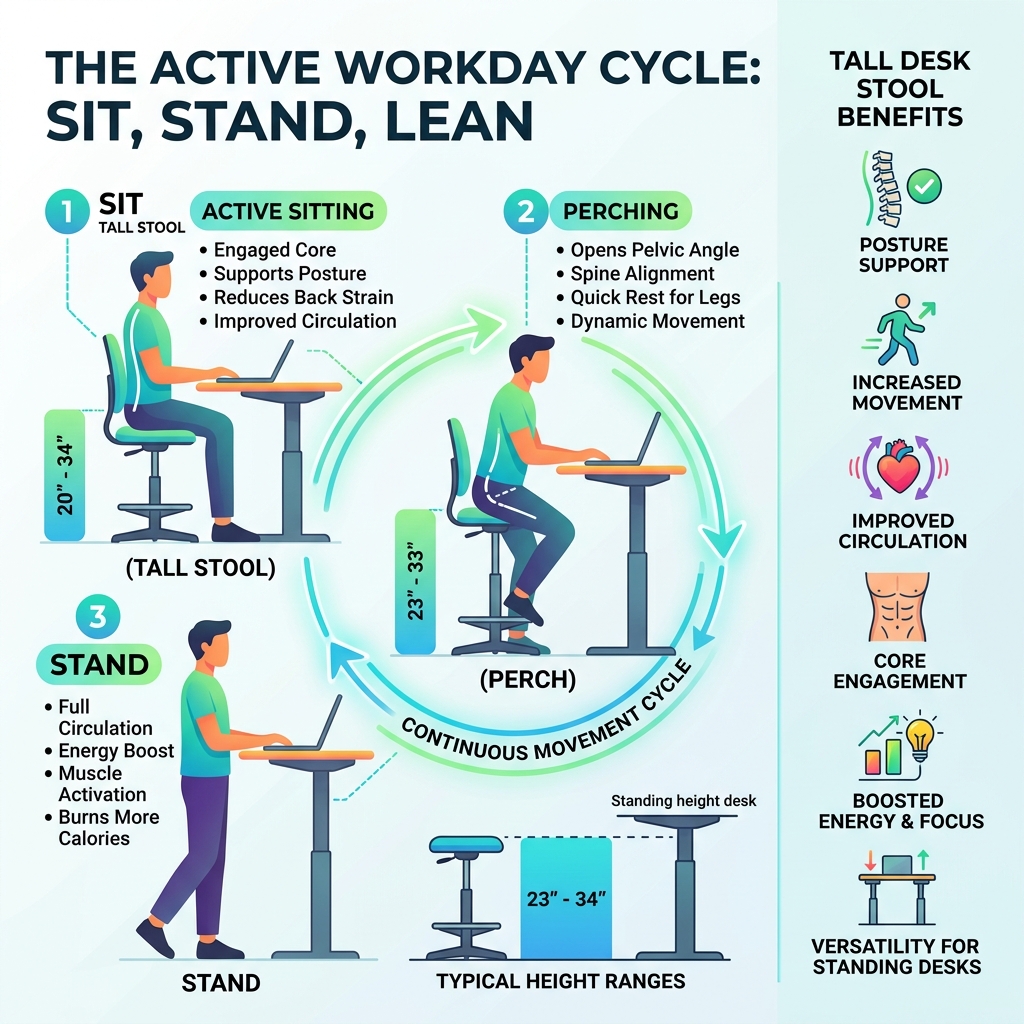
When we talk about a tall desk stool, we aren’t just talking about a taller version of a kitchen stool. These are precision-engineered ergonomic tools designed specifically for the “active seating” revolution. Unlike a standard office chair that encourages a static 90-degree sitting posture, a tall stool allows for “perching”—a position where your hips are higher than your knees, creating an open pelvic angle.
This open angle is the secret sauce of ergonomics. It naturally aligns the spine, reduces the pressure on your lumbar discs, and makes it nearly impossible to slouch. If you have ever felt your energy drain while sitting in a traditional plush chair, it’s likely because your body has gone into a “power-down” mode. Active seating keeps your large muscle groups slightly engaged, which boosts blood flow and keeps you more alert.
The primary difference lies in the range of motion and the height adjustment. Most standard chairs top out around 20 to 22 inches. A tall desk stool typically utilizes an extended pneumatic lift, reaching heights of 32 to 35 inches. This allows you to transition from a full sit to a “leaning” position at your standing desk without having to lower the desk itself.
By incorporating these stools into your routine, you can effectively stop the slump with these ergonomic desk stools, moving between sitting, standing, and perching throughout the day to keep your metabolic rate higher and your back happier.
Key Features to Look for in a Tall Desk Stool
Choosing a tall desk stool isn’t just about picking a color that matches your office rug. Because these stools are used at higher elevations, safety and build quality become paramount. We recommend looking for several specific “non-negotiables” before hitting the “buy” button.
Safety and Build Standards
First, check for BIFMA standards (Business and Institutional Furniture Manufacturers Association). This certification ensures the stool has been tested for durability and stability under commercial-grade use. For our “Big & Tall” friends, weight capacity is a critical metric. While many standard stools support up to 250 lbs, heavy-duty models like the Vue™ can support up to 350 lbs with reinforced swivel-tilt mechanisms.
Movement and Adjustability
A great stool should offer a wide range of motion. This might include a 360-degree swivel or a tilting base that allows you to lean in any direction. Some models, like the Vari Active Seat, feature an articulating pedestal that encourages micro-movements. This keeps your core engaged and prevents the “stiffening” effect of static sitting.
Health and Toxicity
At FinanceInvestX, we are passionate about workspace health, which extends to the air you breathe. Many office furniture pieces off-gas volatile organic compounds (VOCs). Look for GREENGUARD Certification or GREENGUARD Gold. These certifications indicate the product has low chemical emissions, ensuring your ergonomic upgrade doesn’t come at the cost of your indoor air quality. Choosing non-toxic ergonomic desk stools is a vital step for any health-conscious professional.

Comparison: Wobble Bases vs. Fixed Pedestals
| Feature | Wobble/Active Base | Fixed Pedestal/Casters |
|---|---|---|
| Core Activation | High (constant micro-adjustments) | Low (static support) |
| Stability | Dynamic (requires balance) | High (stable foundation) |
| Primary Use | Short-term tasks, active work | Long-term sitting, precision work |
| Mobility | Usually stationary base | Often includes wheels/casters |
Top-Rated Styles for Your Elevated Workstation
The market for tall desk stools has exploded, leading to several distinct “architectures” of seating. Depending on how you work—whether you are an architect leaning over blueprints or a trader glued to six monitors—one of these styles will likely suit you better than the others.
The Versatility of the Saddle Tall Desk Stool
The saddle stool is a favorite among dental practitioners and healthcare professionals for a reason. Its unique shape forces the pelvis into a neutral, forward-tilted position. This drops the knees below the hips and aligns the spine in its natural “S” curve.
By supporting the thighs and opening the hips, saddle stools like those found at Branch Furniture or the Humanscale Freedom models at UPLIFT Desk can provide immense relief for those suffering from hip bursitis or lower back stiffness. It’s a design that prioritizes long-term spinal health over short-term “cushy” comfort.
Active Motion and Wobble Tall Desk Stool Options
If you are someone who “fidgets” or finds it hard to stay still, a wobble stool is your best friend. These stools, such as the Mount-It! MI-932 or the Vari Active Seat, use a rounded base or an articulating pedestal.
The goal here is core activation. Because the stool is slightly unstable, your body must engage its stabilizing muscles (abs, obliques, and lower back) to stay upright. This doesn’t feel like a workout, but over an 8-hour day, it burns more calories and keeps your muscles from becoming dormant. The Haworth Tilt Stool is a premium example of this, offering a 23.5″ to 34.75″ height range with a base that allows for balanced mobility in every direction.
Maximizing Productivity and Health at Elevated Workstations
Buying the stool is only half the battle; using it correctly is where the real ROI (Return on Investment) happens. When you first transition to a tall desk stool, your body might go through a “break-in” period.
Many users report initial soreness in the shins or feet during the first two weeks. This is normal! You are using muscles that have been “asleep” in your standard office chair. We suggest starting with 20-30 minute sessions and gradually increasing your time.
The Importance of Accessories
To truly maximize your comfort, consider what is happening under your feet. When you are perching or leaning, your weight is distributed differently. An anti-fatigue mat is a game-changer here, as it provides a cushioned surface that encourages small foot movements.
Furthermore, if you are using an extra-tall stool, a footrest or a built-in footring is essential. Without one, your legs might dangle, which can lead to “pins and needles” or restricted circulation. Stools like the Deluxe Extra Tall Airlift Stool include adjustable footrings to ensure your legs are supported regardless of your height. You can sit, stand, and smile with these anti-fatigue desk stools and accessories to create a complete ergonomic ecosystem.
Frequently Asked Questions about Tall Desk Stools
How high should a tall desk stool be for a standing desk?
Your stool should be adjusted so that when you are sitting or perching, your elbows remain at a 90-degree angle to your desk surface. For most users, this means a seat height between 24″ and 32″. If you are using a VariDesk Tall 40 or a similar converter, you may need a stool that reaches the higher end of that spectrum (up to 34″) to maintain proper ergonomics.
Can I use a tall stool for an 8-hour workday?
Most ergonomic experts suggest using a tall desk stool as a complementary seating option rather than a 100% replacement for a standard chair. Because many of these stools lack backrests (to encourage core engagement), using them for 8 hours straight can lead to fatigue. The “sweet spot” is often alternating between standing, perching on your stool, and sitting in a traditional ergonomic chair every 60 to 90 minutes.
Do tall stools require a footring or footrest for stability?
While not strictly required for stability, a footring or footrest is highly recommended for comfort. When sitting at an elevated height, having a place to rest your feet prevents pressure on the underside of your thighs, which maintains healthy blood flow. Models like the Sit-To-Stand Desk Chairs at OfficeChairsUSA often feature these as standard equipment for this exact reason.
Conclusion
At FinanceInvestX, we believe that your workspace is an investment in your most valuable asset: your health. Transitioning to a tall desk stool is more than just a furniture change; it’s a commitment to a more dynamic, active, and productive workday.
By choosing stools with high-quality pneumatic lifts, BIFMA-tested durability, and non-toxic GREENGUARD certifications, you are protecting both your spine and your respiratory health. Whether you opt for the core-engaging wobble of a Vari seat or the clinical precision of a saddle stool, the goal remains the same—to keep your body moving so your mind can focus.
The ROI on ergonomics is clear: less pain equals higher focus, which leads to better professional outcomes. Don’t let a static chair hold back your potential. Explore our full guide to ergonomic office furniture to find the next piece of your high-performance workspace.