Your Chair Is Costing the Planet More Than You Think
Best sustainable office seating is no longer a niche category — it’s where comfort, health, and environmental responsibility finally meet.
Here are the top options to know about:
| Chair | Key Sustainability Feature | Best For |
|---|---|---|
| Humanscale Path | 9.49 lbs ocean plastic, climate positive | Premium eco-ergonomics |
| Steelcase Think (4D) | 99% recyclable, 44% recycled materials | High recyclability |
| Herman Miller Mirra 2 | 93% recyclable, 45% recycled content | Balanced sustainability |
| Ahrend Remode | 98.7% recyclable, 50.1% recycled materials | Modular circular design |
| Humanscale Smart Ocean | ~2 lbs reclaimed fishing nets, Net Positive | Ocean plastic impact |
The numbers are hard to ignore. In 2018 alone, the US generated over 12 million tons of furniture waste — much of it from conventional office chairs heading straight to landfill. Meanwhile, the average worker spends thousands of hours sitting each year.
That’s a lot of back pain. And a lot of waste.
The good news? The office furniture industry is changing fast. Brands are now building chairs from recycled fishing nets, upcycled ocean plastic, and bamboo — while also designing for easy disassembly, repair, and recycling at end of life.
And it’s not just good for the planet. Non-toxic materials mean cleaner indoor air. Better ergonomics mean less back pain and fatigue. Longer-lasting chairs mean less money spent replacing them every few years.
Over 73% of Gen Z consumers say they’ll pay more for sustainable products. If you’re outfitting a modern workspace, sustainable seating isn’t just ethical — it’s smart business.
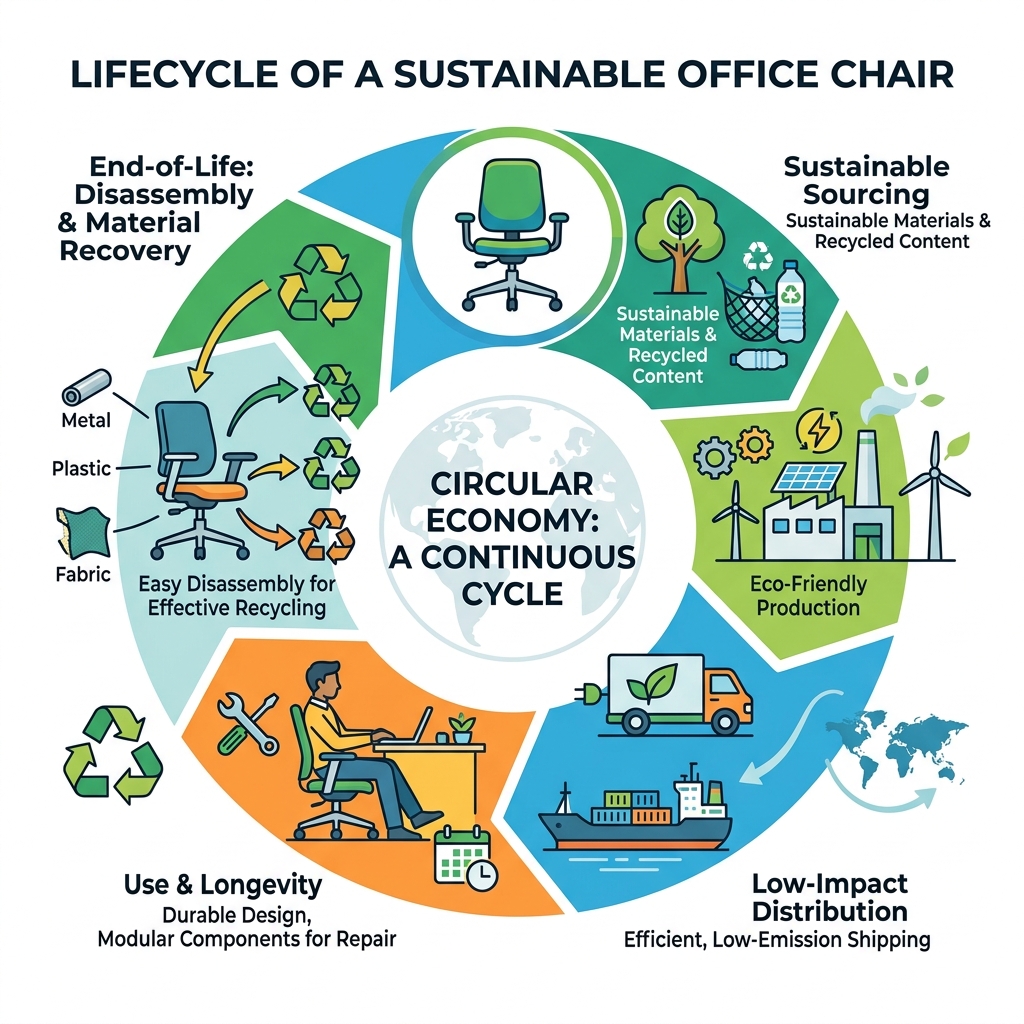
What Defines the Best Sustainable Office Seating?
When we talk about the best sustainable office seating, we aren’t just looking for a “green” label. True sustainability in furniture is a comprehensive approach that covers how a chair is born, how it lives, and where it goes when it “dies.”
At the heart of this is circular design. Instead of the traditional “take-make-waste” model, circular design ensures that every part of a chair can be reused, repaired, or recycled. We look for chairs designed for easy disassembly—like the Steelcase Think, which can be taken apart in about five minutes with basic tools. This modularity means if a single wheel breaks, you replace the wheel, not the whole chair.
Another gold standard we look for is Net Positive impact. As highlighted by Sustainable Office Furniture – Climate Positive Products – Humanscale, some manufacturers are moving beyond “doing less harm” to actually “doing more good.” A Net Positive chair gives back more to the environment than it takes during its production. This includes being climate positive (sequestering more carbon than emitted), water positive (cleaning more water than used), and energy positive (generating more renewable energy than consumed).
Durability and recyclability are the twin pillars of waste reduction. A chair that lasts 10 to 15 years is inherently more sustainable than a “fast furniture” alternative that ends up in a landfill after 24 months. When a chair finally reaches its end of life, the best sustainable office seating options are often 90% to 99% recyclable, ensuring the materials stay in the economy and out of the ground.

Top Eco-Friendly Brands and Product Innovations
The innovation in materials today is nothing short of science fiction. We are seeing a massive shift toward closed-loop manufacturing, where waste from one industry becomes the raw material for another.
One of the most exciting developments is the use of recycled ocean plastic. Discarded fishing nets, known as “ghost nets,” are incredibly damaging to marine life. Brands like Humanscale and Flokk are now harvesting these nets and transforming them into high-grade nylon pellets for chair frames and components. Similarly, upcycled plastic bottles are being spun into high-performance 3D knit textiles that provide ergonomic support with zero fabric waste during production.
Top Picks for the Best Sustainable Office Seating
If you are looking for the absolute pinnacle of eco-innovation, these models lead the pack:
- Humanscale Path: This is arguably the world’s most sustainable task chair. Each Path chair uses about 9.49 lbs of ocean plastic (including fishing nets and recycled yogurt cups). It features a patented Gravity Mechanism that uses your body weight to provide support, eliminating the need for complex, plastic-heavy manual adjustment knobs.
- Steelcase Think: A pioneer in the space, the Think chair is made with up to 44% recycled materials and is 99% recyclable. It’s a masterclass in transparency and material health.
- Herman Miller Mirra 2: With a 25% smaller carbon footprint than the original, the Mirra 2 is 93% recyclable. It’s a great example of how established brands are iterating on classic designs to meet modern environmental standards. You can learn more about how these designs impact your physical health at best-eco-friendly-desk-chairs-for-posture.
- Ahrend Remode: Designed by Ben van Berkel, the Ahrend Remode is a modular powerhouse. It is 30% lighter than the average office chair, which significantly reduces the CO2 footprint associated with shipping. It uses 62% recycled ocean plastic in its components and is 98.7% recyclable.
Affordable and Refurbished Best Sustainable Office Seating
We understand that “Net Positive” often comes with a premium price tag. However, sustainability should be accessible to everyone. One of the most eco-friendly moves you can make is to opt for refurbished programs.
Buying a high-quality second-hand chair from a reputable refurbisher keeps a premium product in use and prevents it from entering the waste stream. Many brands now offer take-back schemes, where they collect old furniture to refurbish or responsibly recycle it.
If you prefer natural materials, there are also affordable-recycled-wood-office-chairs that offer a warm, organic aesthetic without the environmental cost of virgin timber. By choosing refurbished or modularly reconfigurable furniture, you are actively participating in landfill diversion while saving on costs.
Verifying Sustainability: Materials and Certifications
How do you know if a brand is actually green or just “greenwashing”? You look at the ingredients and the third-party stamps of approval.
Sustainable materials generally fall into three categories:
- Recycled/Upcycled: Fishing nets, ocean-bound plastic, and post-consumer metals.
- Renewable/Bio-based: Bamboo (which grows incredibly fast and absorbs CO2), hemp (requires very little water), and cork.
- Natural/Ethical: FSC-certified wood ensures the timber comes from responsibly managed forests. Vegetable-tanned leather is a byproduct of the meat industry that avoids the harsh chemicals used in traditional chrome tanning.
For those concerned about chemical sensitivity, choosing non-toxic-ergonomic-office-chairs is vital. These chairs avoid “Red List” chemicals like PVC, phthalates, and formaldehyde.
Essential Eco-Certifications
To verify these claims, we look for several key certifications:
- Cradle to Cradle (C2C): One of the most rigorous standards. It assesses material health, product circularity, clean air, and social fairness.
- Greenguard Gold: Ensures the chair has low chemical emissions, which is essential for maintaining healthy indoor air quality.
- BIFMA Level 3: The highest level of the furniture industry’s sustainability standard.
- Living Product Challenge: A certification for products that are Net Positive in terms of energy, water, and carbon.
- Red List Free: A declaration that the product contains none of the worst-in-class chemicals found in the building industry.
Health, Productivity, and Business Value
Choosing the best sustainable office seating isn’t just a “feel-good” move; it has tangible benefits for your health and your bottom line.
Conventional office furniture can “off-gas” Volatile Organic Compounds (VOCs) for years. These chemicals can cause headaches, respiratory issues, and fatigue. By choosing low-VOC finishes and non-toxic materials, you improve indoor air quality, which directly correlates with better cognitive function and employee wellness. For those who prefer more active sitting, we often recommend non-toxic-ergonomic-desk-stools to encourage movement and core engagement without chemical exposure.
From a business perspective, sustainability is a powerful tool for brand reputation. It signals to both clients and employees that your company values long-term thinking over short-term savings. Furthermore, many regions offer LEED incentives or tax benefits for businesses that furnish their offices with certified sustainable products. With Gen Z and Millennials making up a larger portion of the workforce, providing an eco-conscious environment is a key factor in talent attraction and retention.
Frequently Asked Questions about Sustainable Seating
What makes an office chair “Net Positive”?
A Net Positive chair goes beyond being “neutral.” Through its manufacturing process, it actually restores the environment. For example, it might use captured rainwater in production, generate more solar power than it consumes, and incorporate waste (like ocean plastic) that would otherwise damage ecosystems. Humanscale is a leader here, with over 60% of their products certified as Net Positive.
Are sustainable office chairs as durable as traditional ones?
In many cases, they are more durable. Sustainable design prioritizes quality materials like solid FSC wood, high-grade recycled nylon, and modular parts. While a cheap plastic chair might break and need replacing in two years, a high-end sustainable chair is often built to last 10 to 15 years and comes with an extensive warranty (often up to 15 years).
How do recycled fishing nets become office furniture?
Discarded nylon fishing nets are collected from the ocean or coastal communities. They are cleaned, shredded, and melted down into small plastic pellets. These pellets are then injection-molded to create the structural components of the chair. Each Humanscale Smart Ocean chair, for instance, incorporates nearly 2 lbs of this reclaimed material.
Conclusion
At FinanceInvestX, we believe that your workspace should be an investment in both your productivity and the planet’s future. Selecting the best sustainable office seating is a decision that pays dividends in ergonomic efficiency, workspace health, and ethical manufacturing.
By choosing chairs that embrace circular design, non-toxic materials, and net-positive production, you are moving away from the “throwaway” culture of the past and toward a more resilient, healthy future. Whether you are outfitting a large corporate headquarters or a small home office, the choices you make today define the environment of tomorrow.
For more deep dives into workspace health and high-quality furniture options, visit our full collection at https://financeinvestx.com/category/furniture/.