Why the Best Ergonomic Stool Reviews Matter for Your Back and Productivity
The best ergonomic stool reviews can save you from wasting money on the wrong seat — and save your back from years of unnecessary pain.
Quick Answer: Top Ergonomic Stools at a Glance
| Stool | Best For | Price Range |
|---|---|---|
| Sitmatic Pogo | Overall active sitting | ~$498 |
| Aeris Swopper | Dynamic movement | ~$500+ |
| UPLIFT Starling | Budget standing desk use | ~$159 |
| Varier Move | Classic motion seating | ~$579 |
| Steelcase Buoy | Mobile office workers | ~$500+ |
| Humanscale Freedom Saddle | Medical/professional use | ~$400+ |
If you work at a desk for long hours, you’ve probably felt it — that dull ache in your lower back, the afternoon energy crash, the stiffness that follows you home. Research shows that sitting for the vast majority of your workday raises your risk of back pain, poor circulation, and fatigue. In fact, some experts compare the long-term health impact of prolonged sitting to smoking.
Ergonomic stools offer a different approach. Instead of just sitting, you perch, lean, and shift — keeping your body in subtle motion all day. Studies show active seating can increase energy expenditure by more than 10%, and a 2020 study linked it to reduced fatigue and better productivity.
But not every ergonomic stool works the same way. Some are built for perching at a standing desk. Others use spring-loaded bases or convex bottoms to keep you moving. Choosing the wrong one means discomfort, wasted money, or a stool that gathers dust in the corner.
This guide cuts through the noise with honest, research-backed reviews to help you find the right fit.
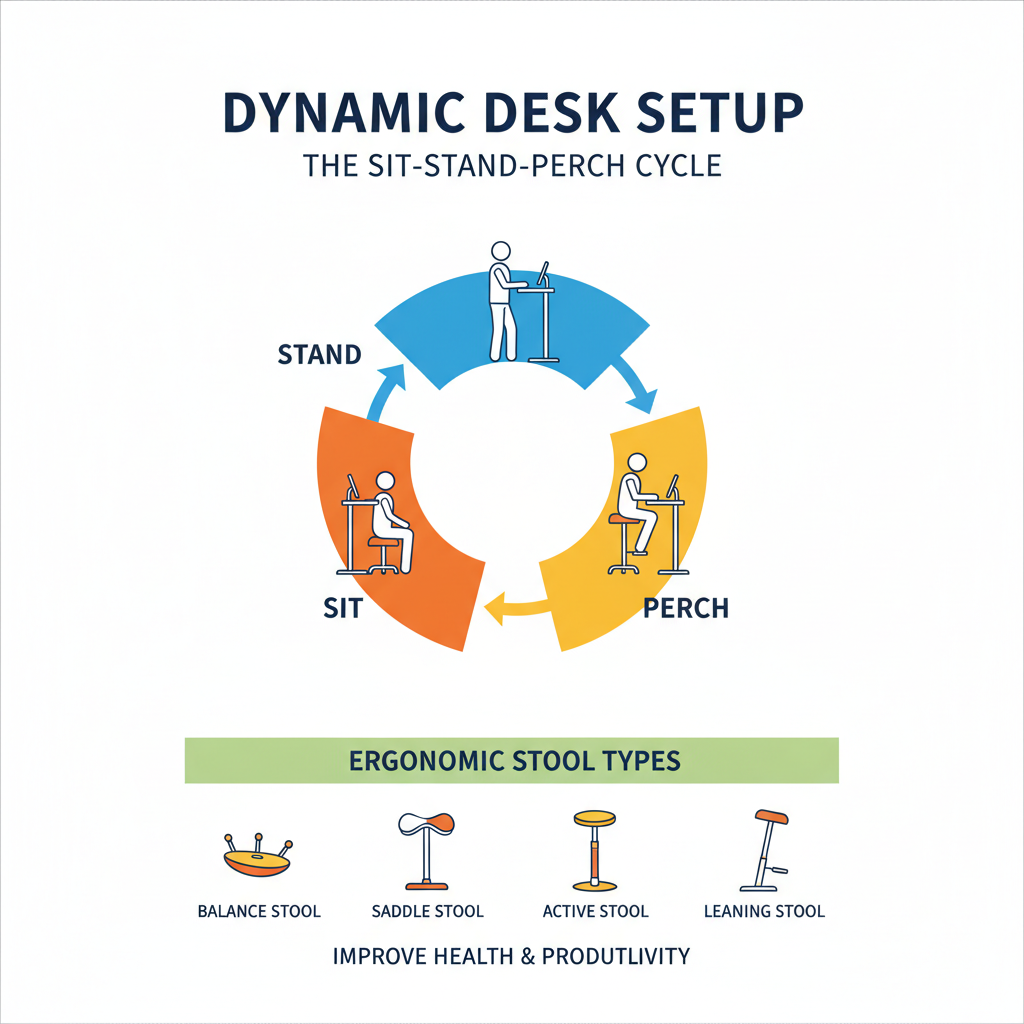
Health Benefits of Active Seating and Dynamic Movement
When we talk about “active seating,” we aren’t suggesting you do a full HIIT workout while answering emails (though that would be impressive). Instead, we are referring to the micro-movements that occur naturally when your seat isn’t a static, padded throne.
Research from institutions like the Mayo Clinic suggests that active seating increases energy expenditure by over 10%. By engaging your core and legs to maintain balance, you turn a sedentary task into a low-intensity physical activity. This constant engagement is a primary reason why many users report a significant reduction in the “afternoon slump.” When your body moves, your brain stays alert.
Core Engagement and Spinal Health
Traditional office chairs do the work of supporting your weight for you. While that sounds nice, it leads to muscle atrophy and “slumping.” Ergonomic stools, particularly those without backrests, force your core muscles to stabilize your spine. This strengthens the lower back over time and reduces the pressure on spinal discs.
Furthermore, many ergonomic stools—especially saddle designs—promote a 135-degree hip angle. This “open” posture is much more natural for the human body than the standard 90-degree bend. It encourages the spine to maintain its natural S-curve, reducing the risk of sciatica and hip flexor tightness.
Circulation and Metabolic Boost
Sitting for 90% of your work hours is a recipe for poor circulation and even carpal tunnel syndrome. By perching or using a motion stool, you keep blood flowing to your lower extremities. For those interested in a holistic approach to their workspace, choosing non-toxic ergonomic desk stools ensures that while you are boosting your metabolism, you aren’t breathing in harmful VOCs often found in cheap foam and synthetic fabrics.
Best Ergonomic Stool Reviews: Top Picks for 2025-2026
To help you navigate the crowded market, we’ve synthesized data from expert testers and real-world users. Here is how the heavy hitters stack up in our best ergonomic stool reviews roundup.
| Model | Height Range | Max Weight | Motion Type |
|---|---|---|---|
| Sitmatic Pogo | 24.5″ – 34.5″ | 300 lbs | 360° Pivot Base |
| Aeris Swopper | 17.7″ – 23.2″ | 265 lbs | 3D Vertical/Lateral |
| UPLIFT Starling | 21″ – 31″ | 297 lbs | 360° Swivel/Tilt |
| Varier Move | 19″ – 34″ | 250 lbs | Convex Rocking Base |
| Steelcase Buoy | 17″ – 22.5″ | 300 lbs | 12° Rocking |
| Backapp 2.0 | 23″ – 32″ | 250 lbs | Adjustable Balance Ball |
Sitmatic Pogo
The Pogo is currently a darling among ergonomic experts, often scoring near the top of independent tests (earning an 86/100 in recent BTOD evaluations). Its standout feature is the massive range of motion. The base stays flat on the floor while the pylon pivots, allowing you to lean deep into your work or reach for a coffee without tipping over. It feels incredibly stable, which is a common complaint with cheaper “wobble” stools.
Aeris Swopper
If you want the “Ferrari” of active motion, the Aeris Swopper is it. It doesn’t just tilt; it bounces. It features a large central spring that allows for vertical movement, mimicking the natural gait of walking. This is the top recommendation for users who want to maximize back muscle strengthening.
UPLIFT Starling
For those looking for a functional entry point into perching, the Starling is a fantastic value. It offers a 10-inch height range, making it compatible with most standing desks. While it lacks the high-end suspension of the Swopper, its stable, non-slip base makes it a reliable companion for short-term perching.
Varier Move
A design icon since 1985, the Varier Move uses a wooden convex base to allow for a constant rocking motion. It is lightweight, easy to move, and encourages a very open hip angle. It’s a “buy once, cry once” investment that lasts for decades.
Best Ergonomic Stool Reviews for Standing Desk Perching
Perching is the “middle ground” between sitting and standing. You aren’t fully weight-bearing on your feet, but you aren’t slumped in a chair either.
- Leanrite Elite: This is less of a stool and more of a standing support system. It allows for a massive height range and includes a tilt function so you can literally lean your back against it while standing. It’s perfect for those who find standing for 8 hours impossible but hate sitting.
- Muvman: Developed by Aeris, the Muvman is the original perching stool. It features a forward-tilted pylon that keeps your center of gravity over your feet, preventing the “sliding off” feeling many tall users experience with cheaper stools.
For those focused on sustainability, pairing these with eco-friendly posture chairs can create a balanced, green workspace.
Best Ergonomic Stool Reviews for Active Motion and Core Strength
If your goal is to ditch the gym and get your core workout at your desk, these motion-heavy options are your best bet.
- Backapp 2.0: This unique stool features a “magic ball” at the bottom. You can turn the ball to increase or decrease the level of instability. It’s widely regarded as one of the best tools for rehabilitating lower back issues through controlled micro-movements.
- Steelcase Buoy: With its built-in handle and 12-degree tilt, the Buoy is designed for the modern, collaborative office. It’s easy to grab and move to a coworker’s desk for a quick 20-minute huddle.
Essential Features for Workspace Ergonomics
When reading the best ergonomic stool reviews, it’s easy to get lost in the marketing jargon. Here is what actually matters for your health and wallet.
Height Range and Adjustability
This is the most critical factor. A stool for a standing desk needs a range that allows your knees to be at a 90-degree angle when sitting, but also allows you to “perch” (hips at roughly 130 degrees) when the desk is raised. Look for a range of at least 10 inches if you plan on using it for both.
Seat Design: Saddle vs. Classic
- Saddle Seats: These mimic a horse-riding position. They are excellent for medical professionals and coders because they force the pelvis into a neutral position. However, they can be an “acquired taste” and may cause initial inner-thigh soreness.
- Classic/Round Seats: These are more familiar and easier to transition into. Look for a “waterfall edge” (a rounded front) to ensure the stool doesn’t cut off circulation to your legs.
Materials and Build Quality
We always recommend looking for non-toxic materials. Many high-end brands like Humanscale use recycled materials and avoid harmful flame retardants. If you are on a budget, you can still find quality—just look for affordable recycled wood office chairs or stools with Greenguard certification.
Setup and Optimization for Standing Desks
Buying the stool is only half the battle; how you use it determines the health outcome.
- The 20-8-2 Rule: A common ergonomic recommendation is to sit for 20 minutes, stand for 8 minutes, and move/stretch for 2 minutes. An ergonomic stool is the perfect tool for that 20-minute “active sit” or “perch.”
- Monitor Height: When perching, your head is higher than when sitting. Ensure your monitor is on an adjustable arm so you can keep the top of the screen at eye level to avoid neck strain.
- Footrest Importance: Expert testers often note that a footrest significantly improves comfort. It allows you to shift your weight to your heels rather than the balls of your feet, which prevents your legs from falling asleep.
- Transition Period: Don’t expect to use a motion stool for 8 hours on day one. You will likely feel soreness in your shins, feet, and core. Start with 30-minute intervals and work your way up over two weeks.
If you find that a stool isn’t enough for your full day, you might consider alternating it with non-toxic ergonomic office chairs that provide full lumbar support for deeper focus sessions.
Frequently Asked Questions about Ergonomic Stools
Are ergonomic stools better than traditional office chairs?
“Better” is subjective. Ergonomic stools are superior for core engagement, posture correction, and energy levels. However, they lack lumbar support and armrests. Most experts suggest using them as a complement to a high-quality chair rather than a 100% replacement for long-term, 8-hour focus work.
Can I use an ergonomic stool for 8 hours a day?
While some “power users” do, most people find that 2 to 4 hours of total stool time spread throughout the day is the sweet spot. Because these stools promote active sitting, your muscles will eventually tire. Rotating between standing, perching, and sitting is the healthiest approach.
What are the best budget ergonomic stools under $200?
You don’t have to spend $600 to get the benefits of active seating.
- UPLIFT Starling: At roughly $159, it offers great height range and a stable base.
- Songmics Standing Stool: Often found around $120-$150, it offers an 8-degree tilt and a comfortable padded seat. The trade-off for budget stools is usually the warranty (often 1-3 years versus 12 years for premium brands) and the “smoothness” of the gas lift.
Conclusion
At FinanceInvestX, we believe that your workspace is an investment in your most valuable asset: your health. Choosing the right seat—backed by our best ergonomic stool reviews—can lead to higher productivity, fewer sick days, and a much happier back.
Whether you opt for the bouncing motion of the Aeris Swopper or the budget-friendly perching of the UPLIFT Starling, the key is to keep moving. Don’t let your desk become a place of stagnation.
Ready to overhaul your entire office setup? Explore our full furniture category for more deep dives into the best gear for a healthy, high-performance workspace.